A smartphone battery plays a crucial role in the performance and reliability of your…
Read More

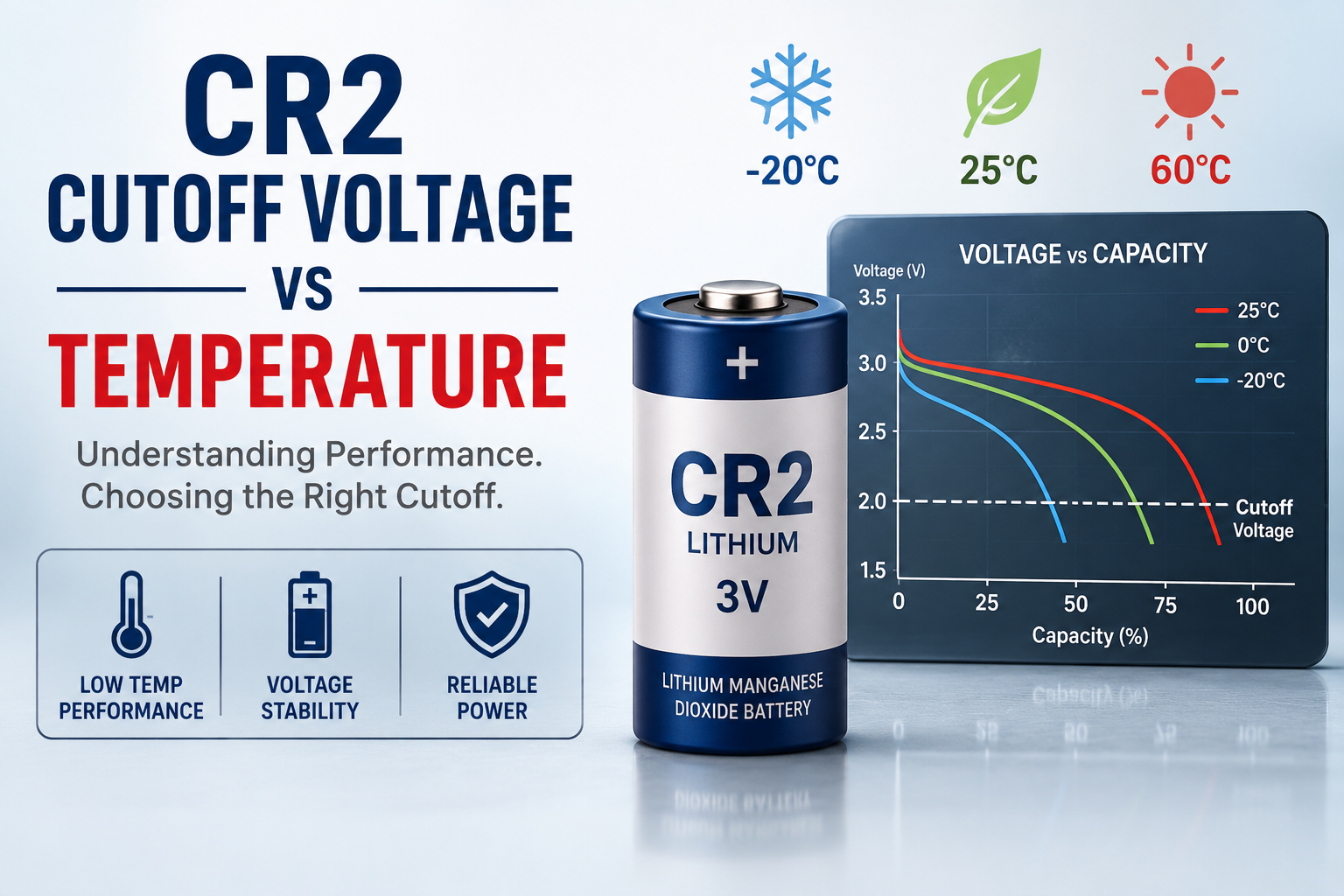
A CR2 battery looks simple from the outside: a compact 3V lithium primary cell designed to provide dependable power in cameras, sensors, security devices, medical equipment, lighting products, and other electronics. But when a CR2 battery is used in a real device, its voltage does not remain fixed at 3V.
Temperature, discharge current, internal resistance, battery chemistry, aging, and the device’s minimum operating voltage all influence how the cell behaves.
That is why understanding CR2 cutoff voltage vs temperature is important when designing or troubleshooting battery-powered equipment.
A device may continue operating normally at room temperature but shut down unexpectedly in cold conditions. In another application, a battery may appear to have usable capacity when measured without a load but fail when a high-current pulse is applied.
The important lesson is simple: a CR2 battery’s nominal voltage is not the same thing as its usable voltage under every operating condition.
Manufacturer datasheets make this clear. Panasonic lists its standard CR2 at 3V nominal voltage and provides temperature-dependent discharge characteristics, while Energizer specifies its CR2 at 3.0V nominal voltage with a typical capacity rated to a 2.0V endpoint under its stated test conditions.
What Is the Cutoff Voltage of a CR2 Battery?
The CR2 battery cutoff voltage is the voltage selected as the endpoint of a discharge test or as the minimum voltage at which a particular application is considered to have reached its usable limit.
There is an important distinction here: there is no single universal cutoff voltage that applies to every CR2 application.
For example, Energizer specifies its CR2 typical capacity as 800mAh when discharged to 2.0V at 21°C under a stated 100-ohm test condition. Panasonic’s CR2 datasheet presents discharge characteristics using a 1.8V cutoff in its graph.
Therefore, saying “a CR2 is dead at exactly X volts” without specifying the manufacturer, load, temperature, and application can be misleading.
A device designer should instead ask:
What minimum voltage does my device require under its actual load and temperature conditions?
That question is much more useful than simply asking for the nominal battery voltage.
CR2 Nominal Voltage vs Cutoff Voltage
A standard CR2 lithium battery normally has a nominal voltage of approximately 3.0V.
But three different voltage concepts should be kept separate:
| Voltage Term | Meaning |
|---|---|
| Nominal voltage | The approximate rated operating voltage of the cell |
| Operating voltage | The voltage observed while the battery is powering a load |
| Cutoff voltage | The selected endpoint below which the discharge test or application stops |
For a typical CR2, the nominal voltage is 3.0V. Energizer lists its CR2 as a 3.0V lithium/manganese dioxide cell, while Panasonic also specifies 3V nominal voltage.
The actual terminal voltage can be higher when the cell is fresh and unloaded and lower when current is being drawn.
This difference becomes particularly important in devices that require short bursts of relatively high current.
How Temperature Affects CR2 Battery Voltage
Temperature has a significant influence on primary lithium battery performance.
The biggest practical concern is usually low temperature.
At lower temperatures, the electrolyte and electrochemical processes inside the cell behave differently. Internal resistance can increase, which can cause greater voltage drop when the device draws current.
Murata’s technical documentation for lithium manganese dioxide batteries explains that internal resistance influences voltage drop and that high drain can cause the battery voltage to fall enough for a device to become inoperable even when usable capacity remains. It also notes that low-temperature conditions affect battery utilization.
This creates an important scenario:
The battery may not actually be empty, but the device can still shut down because the loaded voltage has fallen below its minimum operating voltage.
That distinction is critical for engineers working with outdoor sensors, security equipment, IoT devices, cameras, and other electronics exposed to changing temperatures.
CR2 Discharge Characteristics at Different Temperatures
The CR2 discharge characteristics change as the temperature changes.
At moderate temperatures, the discharge curve of a lithium manganese dioxide cell can remain relatively stable for much of its useful discharge period.
At lower temperatures, however, the voltage under load can drop more noticeably.
A simplified representation looks like this:
| Temperature Condition | Typical Effect |
| Warm / moderate temperature | Lower internal resistance and better load performance |
| Room temperature | Reference condition for many capacity tests |
| Around 0°C | Increased voltage drop can become noticeable |
| Below 0°C | Greater impact on voltage under load and usable capacity |
| Very high temperature | Lower resistance may improve immediate discharge performance, but aging and storage degradation can accelerate |
These are general behavioral trends, not universal numerical performance values for every CR2 model. Actual results should always be taken from the manufacturer’s discharge curves for the exact cell being used.
Panasonic’s CR2 datasheet specifically includes discharge-temperature characteristics and rates the standard cell for operation from -40°C to +70°C, while recommending consultation for some extreme portions of that range.
Why Low Temperature Can Make a CR2 Appear “Dead”
Imagine a sensor powered by a CR2 battery.
At 25°C, the battery may provide sufficient voltage for the sensor to operate normally.
Now place the same sensor outdoors during a cold winter night.
The battery may still contain substantial chemical energy. However, increased internal resistance can cause the terminal voltage to sag when the sensor activates its radio, transmitter, LED, or other high-current load.
If the voltage temporarily falls below the device’s minimum operating voltage, the sensor may:
- Restart
- Enter a brownout condition
- Fail to transmit
- Trigger a low-battery warning
- Stop operating temporarily
After the load is removed, the battery voltage can recover.
This is why measuring a CR2 with a multimeter while it is disconnected from the device may not tell the complete story.
CR2 Voltage Under Load vs Open-Circuit Voltage
One of the most common mistakes in battery troubleshooting is checking only open-circuit voltage.
An unloaded battery may show a healthy-looking voltage.
But when the device demands current, the voltage can drop because of the cell’s internal resistance.
A simplified relationship is:
V_loaded = V_oc − I × R_internal
Where:
- V_loaded = voltage available at the device under load
- V_oc = open-circuit voltage
- I = load current
- R_internal = internal resistance of the battery
This is not a complete electrochemical model, but it is useful for understanding why voltage can fall sharply during a high-current event.
As temperature decreases and internal resistance rises, the voltage drop associated with the same current can become more significant.
Murata specifically highlights this relationship in its technical documentation for CR-type lithium manganese dioxide batteries.
Does the CR2 Cutoff Voltage Change With Temperature?
This question needs a careful answer.
The nominal cutoff specification does not automatically change simply because the ambient temperature changes.
Instead, what changes is the battery’s discharge behavior at that temperature.
For example, if a manufacturer defines a capacity test down to a particular endpoint voltage, that endpoint remains part of the test definition. But the amount of capacity delivered before reaching that voltage can vary with temperature and load.
In addition, a real device may have its own minimum operating voltage.
Therefore, there are two separate considerations:
- Battery manufacturer’s discharge endpoint
- Device’s minimum required operating voltage
A designer must consider both.
This is why the exact manufacturer’s CR2 battery datasheet is more useful than a generic cutoff-voltage number copied from a battery chart.
CR2 Battery Capacity and Temperature
Battery capacity is not an absolute number independent of conditions.
Energizer lists a typical CR2 capacity of 800mAh to 2.0V under a specified 100-ohm load at 21°C. Panasonic lists 850mAh for its standard CR2 and provides discharge characteristics for temperature and load conditions.
This means you should not assume that an 800mAh or 850mAh rating will be delivered identically in every application.
Capacity depends on factors including:
- Temperature
- Discharge current
- Cutoff voltage
- Pulse profile
- Cell construction
- Age
- Storage conditions
- Device load pattern
For low-power applications, a CR2 can provide long service life. For high-current applications, usable capacity may be significantly different from the headline rating.
CR2 Battery Temperature Range
The CR2 battery temperature range depends on the manufacturer and specific product.
For example, Panasonic specifies an operating range of -40°C to +70°C for its standard CR2, with consultation recommended for operation between -40°C and -20°C or between 60°C and 70°C.
Energizer specifies -40°C to +60°C operating temperature for its CR2.
This comparison demonstrates why engineers should never assume that every CR2 sold by different manufacturers has identical temperature specifications.
| Manufacturer Example | Nominal Voltage | Typical Capacity | Stated Operating Temperature |
| Panasonic CR2 | 3.0V | 850mAh | -40°C to +70°C* |
| Energizer CR2 | 3.0V | 800mAh | -40°C to +60°C |
*Panasonic recommends consultation for certain extreme temperature conditions.
What Happens at High Temperature?
High temperature can produce a different set of effects.
Higher temperatures can reduce internal resistance and may improve short-term voltage performance under load.
However, that does not mean that operating a battery at high temperature is always beneficial.
Extended exposure to high temperatures can accelerate aging and reduce long-term performance.
This is an important distinction:
Better immediate discharge performance does not necessarily mean better battery life.
Battery storage and operating temperature should therefore be considered separately.
For example, Murata notes that standard CR lithium coin cells generally operate over a specified range and offers separate extended-temperature and heat-resistant product families for applications requiring more demanding conditions.
CR2 Cutoff Voltage and IoT Applications
CR2 cells are attractive for many low-power electronic devices because they combine compact size, approximately 3V nominal voltage, low self-discharge, and useful energy density.
Applications can include:
- Wireless sensors
- Security devices
- Electronic locks
- Cameras
- Medical equipment
- Lighting products
- Industrial monitoring equipment
- IoT devices
Panasonic lists applications including security devices, automotive electrical components, medical devices, and lights for its CR2.
For IoT applications, the battery should be evaluated according to the complete load profile rather than average current alone.
A device that sleeps at a few microamps but periodically transmits at a much higher current may experience voltage behavior very different from a device that continuously draws a small current.
How to Select the Right CR2 Cutoff Voltage
If you’re designing a circuit around a CR2, follow a practical process.
Step 1: Identify the Device Minimum Voltage
Find the minimum voltage required by the electronics.
For example, if your circuit requires at least 2.4V during operation, that becomes an important design limit.
Step 2: Identify the Maximum Load
Determine both:
- Average current
- Peak or pulse current
The peak load can be especially important because voltage sag can occur during high-current events.
Step 3: Check the Battery Datasheet
Look for:
- Discharge curves
- Temperature curves
- Pulse performance
- Recommended discharge current
- Operating temperature
- Capacity test conditions
Step 4: Test at the Lowest Expected Temperature
If the device will operate outdoors, test it at the actual minimum expected temperature.
Do not assume room-temperature testing is sufficient.
Step 5: Define the Device Cutoff
Your firmware or hardware low-voltage threshold should provide enough margin to keep the device stable without unnecessarily discarding usable battery energy.
Common Mistakes When Designing With CR2 Batteries
Mistake 1: Treating 3.0V as a Constant
A CR2 is nominally 3.0V, but the terminal voltage changes throughout discharge and with load.
Mistake 2: Using Only Room-Temperature Data
A device designed at 25°C may behave differently at 0°C or below.
Mistake 3: Ignoring Pulse Current
Wireless communication and radio transmission can create short, high-current demands.
Mistake 4: Using a Generic Cutoff
A cutoff suitable for one device may not be suitable for another.
Mistake 5: Checking Only Open-Circuit Voltage
Loaded voltage is often much more relevant to actual device operation.
Mistake 6: Assuming All CR2 Batteries Are Identical
Different manufacturers can specify different capacity test conditions, operating ranges, and discharge behavior.
Practical Testing Method for CR2 Temperature Performance
If you’re evaluating a CR2 for an engineering application, a controlled test is much more useful than relying on a generic chart.
A practical test can include:
- Select the exact CR2 model.
- Measure its initial open-circuit voltage.
- Place the battery at the target temperature.
- Allow sufficient time for thermal stabilization.
- Apply the actual device load or a representative electronic load.
- Record voltage continuously.
- Record current and temperature.
- Monitor the device’s operating status.
- Repeat the test at multiple temperatures.
- Compare usable runtime and minimum loaded voltage.
Useful test points might include:
25°C → 10°C → 0°C → -10°C → -20°C
The exact temperatures should reflect the intended application.
This approach helps reveal whether a low-temperature problem is caused by true battery depletion, voltage sag, insufficient device voltage margin, or another system-level issue.
CR2 Cutoff Voltage vs Temperature: Key Takeaways
The relationship between CR2 cutoff voltage vs temperature becomes much easier to understand once nominal voltage, cutoff voltage, loaded voltage, and capacity are treated as separate concepts.
A CR2 is typically a 3V lithium manganese dioxide primary cell, but its voltage under load depends on temperature, current, internal resistance, and state of discharge.
The most important points are:
- A CR2’s nominal voltage is around 3.0V.
- Cutoff voltage is a defined discharge endpoint, not necessarily a universal “dead battery” voltage.
- Energizer specifies its typical CR2 capacity to 2.0V under stated test conditions.
- Panasonic’s CR2 documentation provides discharge characteristics and uses a 1.8V cutoff in its graph.
- Low temperatures can increase voltage sag and reduce usable capacity.
- High temperatures can improve short-term discharge behavior but accelerate aging.
- Device minimum operating voltage must be considered separately from the battery’s discharge endpoint.
- High-current pulses can cause temporary voltage drops even when capacity remains.
- Exact manufacturer discharge curves should be used for engineering decisions.
The safest approach is to select a battery based on the actual load profile, temperature range, cutoff requirement, and manufacturer’s datasheet, rather than relying on a single voltage figure.
Frequently Asked Questions
What is the normal cutoff voltage for a CR2 battery?
There is no single universal cutoff voltage for every CR2 application. Energizer specifies a 2.0V endpoint for its typical capacity rating under defined test conditions, while Panasonic presents its standard CR2 discharge characteristics using a 1.8V cutoff. Always follow the exact battery manufacturer’s specifications.
Does cold temperature reduce CR2 voltage?
Cold temperatures can reduce the voltage available under load because battery internal resistance and electrochemical behavior change. A CR2 may therefore experience greater voltage sag during high-current events in cold environments.
Can a CR2 still have capacity below the device cutoff?
Yes. A battery can contain remaining chemical capacity while its loaded voltage falls below the minimum voltage required by the device. This is particularly relevant during high-current pulses or low-temperature operation.
What temperature is best for CR2 batteries?
Moderate room-temperature conditions are generally favorable for testing and normal operation. Exact operating limits depend on the battery manufacturer and model. Panasonic and Energizer specify different operating temperature ranges for their CR2 products.
Can I use the same cutoff voltage for every CR2 battery?
It is better not to assume that. Different CR2 manufacturers can specify different discharge test conditions, cutoff endpoints, operating ranges, and performance curves. Use the datasheet for the exact cell.
Why does my CR2-powered device shut down in cold weather?
The battery may experience increased internal resistance at low temperature, causing its voltage to drop significantly when the device draws current. If the loaded voltage falls below the device’s minimum operating voltage, the device may shut down even though the battery is not completely depleted.
Conclusion
Understanding CR2 cutoff voltage vs temperature is essential when a CR2 battery is used in equipment that must operate reliably across changing environmental conditions.
The biggest mistake is to look at the 3.0V nominal rating and assume that the battery will always provide 3.0V to the circuit. In reality, voltage changes with discharge state, current, temperature, internal resistance, and battery condition.
For a reliable design, start with the device’s minimum operating voltage, determine the real current profile, obtain the manufacturer’s discharge curves, and test the battery at the temperatures the product will actually experience.
For production applications, industrial equipment, IoT sensors, security devices, and other battery-powered products, choosing the correct CR2 specification can make the difference between a device that works reliably and one that experiences unexpected low-voltage shutdowns.
When selecting a CR2 battery, do not compare capacity alone. Evaluate voltage behavior, temperature performance, discharge current, pulse capability, operating life, and manufacturer specifications together.

Battery Replacement Service

Battery Replacement Service
A smartphone that once opened apps instantly may gradually start responding more slowly,…
Read More

Android VS IPhone repair
Introduction A damaged screen, a battery that drains too quickly, a faulty charging port,…
Read More