A smartphone battery plays a crucial role in the performance and reliability of your…
Read More

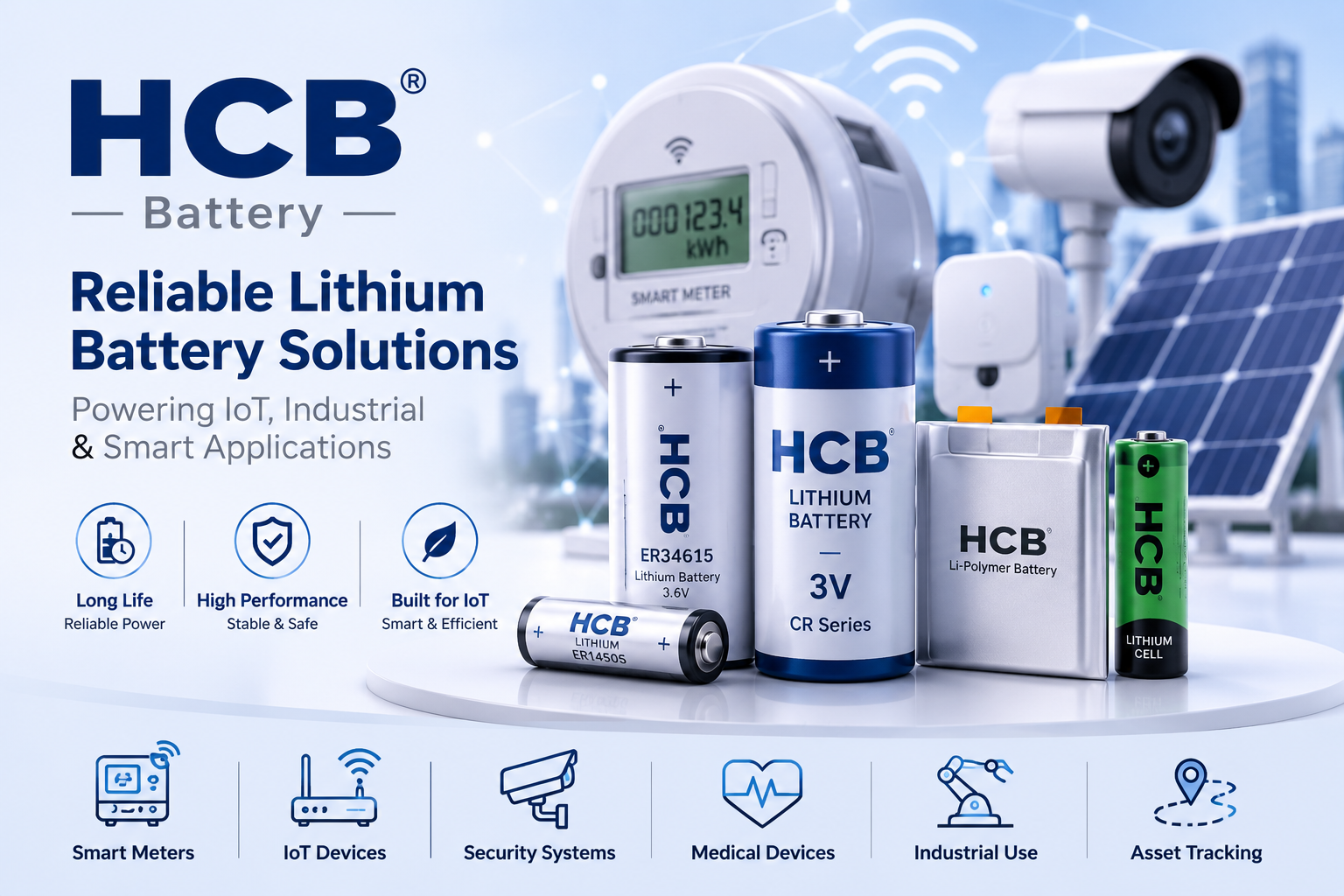
Modern IoT devices, smart meters, security systems, sensors and industrial equipment often need a battery that can operate reliably for long periods with minimal maintenance. This is where HCB lithium battery solutions can be useful.
HCB Battery Co., Ltd. was established in 2004 and focuses on the research, development and manufacturing of primary lithium batteries and other battery technologies. Its product portfolio includes Li-SOCl₂ cylindrical batteries, Li-MnO₂ cylindrical batteries, lithium pouch cells, lithium-ion cylindrical batteries, lithium-ion pouch cells and ultra-pulse capacitors.
HCB states that its batteries are used in applications including utility metering, IoT, alarm systems, asset tracking, medical equipment, GPS/RFID and sensors.
For businesses looking for dependable power solutions, the important question is not simply which battery has the highest capacity. The right battery needs to match the device’s voltage, current requirements, operating temperature, size and expected service life.
What Is HCB Battery?
HCB Battery is a lithium battery manufacturer and solution provider headquartered in Wuhan, China. According to its company information, HCB has more than 20 years of R&D and manufacturing experience and supplies customers internationally.
Its product range covers both primary and rechargeable lithium technologies.
Some major HCB product categories include:
- Li-SOCl₂ cylindrical batteries
- Li-MnO₂ cylindrical batteries
- Super-capacity Li-MnO₂ batteries
- Li-MnO₂ pouch cells
- Lithium-polymer batteries
- Lithium-ion cylindrical batteries
- Lithium-ion pouch cells
- Ultra-pulse capacitors
This broad portfolio allows battery selection to be based on the actual requirements of an electronic product rather than using one battery chemistry for every application.
HCB Lithium Battery Solutions
One of the major strengths of HCB’s portfolio is the availability of different lithium chemistries.
HCB Li-SOCl₂ Batteries
Lithium thionyl chloride batteries are commonly used where long service life and low self-discharge are important.
They can be suitable for applications such as:
- Smart meters
- IoT sensors
- Industrial monitoring
- Security systems
- Tracking equipment
- Utility equipment
HCB offers Li-SOCl₂ batteries in cylindrical configurations, including bobbin and spiral types.
HCB Li-MnO₂ Batteries
Li-MnO₂ is another important primary lithium chemistry.
HCB’s CR series includes Li-MnO₂ cylindrical batteries, while its portfolio also includes Li-MnO₂ pouch cells and super-capacity options.
These batteries can be considered for devices requiring compact primary lithium power and suitable pulse or discharge characteristics.
HCB Battery for IoT Applications
IoT devices often have a challenging power profile.
A sensor may remain in low-power sleep mode for long periods and then suddenly require additional current when it measures data or communicates wirelessly.
This means battery selection needs to consider more than capacity.
For an HCB battery for IoT, engineers should evaluate:
- Average current consumption
- Peak current
- Operating voltage
- Temperature range
- Required battery life
- Physical dimensions
- Communication frequency
- Storage conditions
HCB specifically identifies sensors, smart meters, smart cities, security and asset tracking among its application areas.
HCB Battery for Smart Meters
Smart meters need reliable power because battery replacement can be expensive and inconvenient, particularly when thousands of meters are deployed across a large geographical area.
A suitable lithium battery can help support long-term operation while reducing maintenance requirements.
HCB lists smart meters and utilities among its application scenarios and offers lithium battery technologies designed for these types of applications.
For a smart-meter project, battery selection should consider the meter’s communication system, measurement cycle, temperature exposure and expected operating life.
HCB Battery for Sensors
Sensors are another important application.
Industrial and IoT sensors may be installed in locations where frequent battery replacement isn’t practical.
Examples include:
- Temperature sensors
- Pressure sensors
- Environmental sensors
- Industrial monitoring devices
- Asset-tracking sensors
- Wireless security sensors
The best battery depends on the sensor’s power profile and communication requirements.
A low-power sensor may prioritize long shelf life and low self-discharge, while a device with regular wireless transmissions may require better pulse performance.
HCB Battery Product Comparison
| HCB Battery Type | Chemistry | Typical Application Focus |
|---|---|---|
| ER Series | Li-SOCl₂ | IoT, meters, sensors |
| CR Series | Li-MnO₂ | Consumer and industrial electronics |
| SC Series | Li-MnO₂ | Higher-power/pulse applications |
| CP Series | Li-MnO₂ pouch | Compact electronic devices |
| HCB Li-Polymer | Lithium-ion | Wearables and consumer electronics |
| HLM Series | Li-ion cylindrical | Rechargeable applications |
| RCR Series | Li-ion | Rechargeable applications |
| UPC | Ultra-pulse capacitor | High pulse-power requirements |
The exact model should be selected using the manufacturer’s specifications and the electrical requirements of the final product.
Why Battery Chemistry Matters
Not every lithium battery works the same way.
For example, Li-SOCl₂ and Li-MnO₂ batteries have different voltage characteristics, discharge behavior and application strengths.
Rechargeable lithium-ion batteries are also fundamentally different from primary lithium batteries.
This distinction matters because primary lithium batteries should not simply be treated like rechargeable cells. HCB specifically warns that its ER/CR/DX primary lithium series should not be recharged because doing so can create serious safety risks.
Before selecting a battery, always verify:
Chemistry + Voltage + Capacity + Current + Temperature + Physical Size + Application
HCB Battery for Industrial Applications
Industrial equipment can operate in demanding environments where battery reliability is important.
Depending on the application, batteries may need to handle:
- Wide temperature variation
- Long periods without maintenance
- Low-power operation
- High-current pulses
- Limited installation space
- Remote deployment
HCB’s product information highlights applications including transportation and logistics, medical equipment, oil and gas, smart cities, utilities, security and agriculture.
This makes battery selection an important part of industrial product design.
How to Choose the Right HCB Battery
Choosing a battery should start with the device rather than the battery catalogue.
Step 1: Check Voltage
Determine the operating voltage required by your circuit.
Step 2: Calculate Power Consumption
Understand both average and peak current requirements.
Step 3: Define Operating Temperature
Outdoor IoT equipment may experience much wider temperature changes than indoor electronics.
Step 4: Estimate Required Battery Life
Determine whether the application needs months, several years, or longer service intervals.
Step 5: Check Physical Dimensions
Battery size and terminal configuration must fit the product enclosure.
Step 6: Review the Datasheet
Always verify capacity, discharge characteristics, temperature specifications and safety information for the exact model.
HCB Battery Solutions in India
For Indian businesses working on IoT, smart metering, industrial automation, security and sensor projects, sourcing the correct battery specification is particularly important.
Instead of selecting a battery only by its name or capacity, businesses should evaluate the complete technical requirement.
Galaxmial Predera can help businesses looking for battery solutions and product sourcing support for applications involving IoT devices, industrial electronics, smart meters, sensors and other battery-powered equipment.
For bulk procurement or OEM requirements, businesses should provide details such as:
- Required battery model
- Quantity
- Voltage
- Capacity
- Operating temperature
- Application
- Expected service life
- Required certifications
This makes it easier to identify the appropriate battery solution.
HCB Battery vs Generic Lithium Battery
A generic lithium battery may look cheaper initially, but industrial applications require more than a basic voltage and capacity specification.
| Factor | HCB Battery Solution | Generic Battery |
|---|---|---|
| Product range | Multiple lithium chemistries | Depends on supplier |
| Application support | Industrial and IoT focused | Often general-purpose |
| Technical specifications | Model-specific | May vary |
| OEM/custom requirements | Available depending on product | Supplier dependent |
| Long-life applications | Multiple suitable series | Depends on model |
| Global supply | International customer base | Supplier dependent |
The most important consideration remains whether the selected cell meets the technical requirements of the application.
Why HCB Battery Is Relevant for IoT and Smart Technology
As more equipment becomes connected, power reliability becomes increasingly important.
Smart meters, asset trackers, wireless sensors and security devices may operate in locations where regular maintenance is difficult.
HCB says its batteries are used across smart medical, asset tracking, smart security, smart city, smart meter and sensor applications.
The company’s current product range also includes solutions designed for high-current and pulse-demand applications. Its recent product information highlights ER34615 variants developed for different IoT power requirements.
Frequently Asked Questions
What is HCB Battery?
HCB Battery Co., Ltd. is a lithium battery manufacturer and solution provider established in 2004. It produces primary lithium batteries, lithium-ion products, pouch cells and ultra-pulse capacitor solutions.
What types of batteries does HCB manufacture?
HCB manufactures Li-SOCl₂ cylindrical batteries, Li-MnO₂ cylindrical batteries, Li-MnO₂ pouch cells, lithium-polymer batteries, lithium-ion cylindrical and pouch cells, and ultra-pulse capacitors.
Are HCB batteries suitable for IoT devices?
Yes. HCB identifies IoT, sensors, smart meters, asset tracking and smart-city applications among its target application areas.
Can HCB primary lithium batteries be recharged?
Primary ER/CR/DX lithium batteries should not be recharged. HCB warns that attempting to recharge these batteries can create serious safety problems.
How do I choose the right HCB battery?
Start with the device’s voltage, average and peak current, operating temperature, required service life, physical dimensions and application requirements. Then compare these requirements with the datasheet for the exact HCB model.
Conclusion
HCB Battery offers a broad range of lithium battery technologies for applications ranging from IoT sensors and smart meters to security, medical equipment and industrial electronics.
The main advantage of having multiple battery chemistries and form factors is that engineers can select a solution based on the actual requirements of their device.
For businesses in India looking for an HCB battery supplier, the most important step is to identify the correct battery model rather than selecting a product solely on capacity or price.
Galaxmial Predera can support businesses looking for HCB lithium battery solutions for IoT, industrial and electronic applications.
If you are planning a new IoT device, smart meter, sensor or industrial product, selecting the correct battery at the design stage can improve reliability, reduce maintenance requirements and support longer product life.
Battery Replacement Service
Battery Replacement Service
A smartphone that once opened apps instantly may gradually start responding more slowly,…
Read More
Android VS IPhone repair
Introduction A damaged screen, a battery that drains too quickly, a faulty charging port,…
Read More